Six things a feature list won’t tell you.
The parts of a build that decide whether it still fits in year three.
Built around your systems, not just your courses
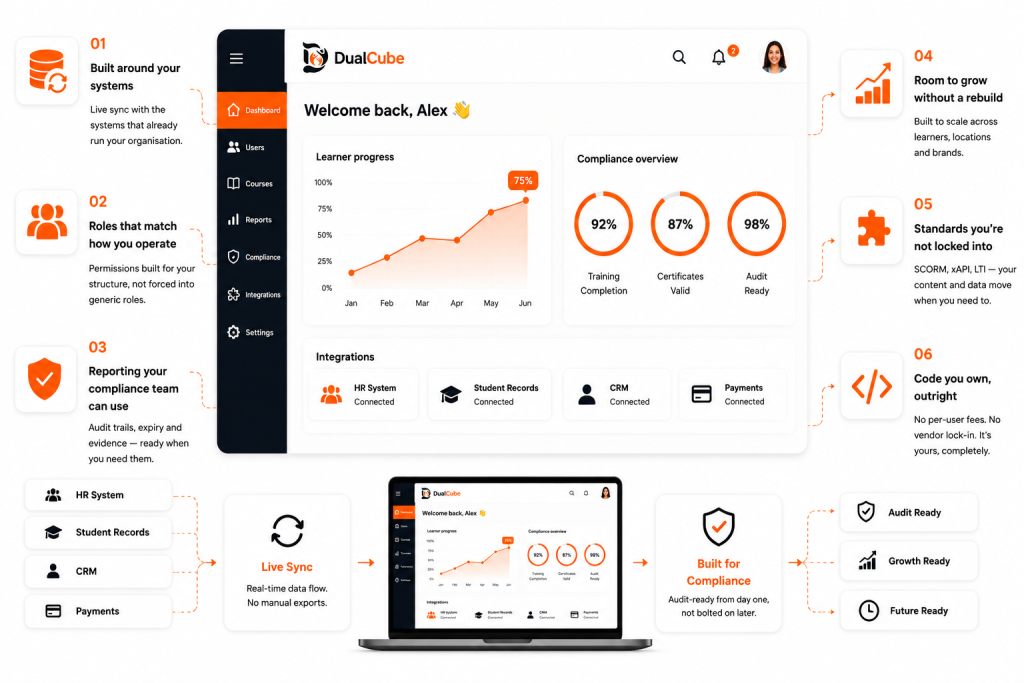
Your LMS talks to whatever already runs your organisation — HR, student records, CRM, payments — through live sync, not a nightly export someone has to remember to run.
Roles that match how you operate
Instructor, manager, franchise admin, external assessor — whatever your structure looks like, permissions are built to it, not bent to fit four generic roles a template gave you.
Reporting your compliance team can use
Audit trails, certificate expiry, completion evidence — built in from the start, not bolted on the week before an inspection.
Room to grow without a rebuild
Architecture that holds at fifty learners and fifty thousand, across one portal or twenty branded ones — because “we’ll deal with scale later” is how custom builds get expensive.
Standards you’re not locked into
SCORM, xAPI, LTI — your content and data move if you ever need them to. Interoperability is what stops a vendor becoming a hostage situation.
Code you own, outright
No per-user licence that climbs every intake. No vendor roadmap you’re waiting on. What we build is yours to run, extend, or hand to another team entirely.
What off-the-shelf actually costs you.
Not the licence fee — the five things that happen after you sign it.
Re-keying enrolment data between two systems that won’t talk
Paying per seat for a platform you’ve already outgrown
Reporting that “mostly” satisfies your auditor
A roadmap that depends on a vendor’s priorities, not yours
Content trapped in a format only one platform reads
None of this shows up in a demo. All of it shows up eighteen months in – exactly when it’s expensive to fix.
You’re probably already running something we built.
MooWoodle, Stripe Payment Pro, Quiz Analytics — live on thousands of Moodle installs, rated 4.3 on WordPress.org. When we build your platform, it’s on ground we’ve stood on for a decade — not a first attempt with your project as the test case.
★ 4.3 on WordPress.org
MooWoodle
Stripe Payment Pro
Quiz Analytics
15+ products over Moodle & WordPress
Architecture before pixels
Buyers who’ve been burned before ask this first: is the data model right before the screens get pretty? We build in that order, every time.
We’ll tell you Moodle already does it
A custom build isn’t always the right call. If a plugin or a configuration gets you there for less, we’ll say so — even though it’s the smaller invoice for us.
Documentation, not dependency
Source code, architecture docs, and a system your own team — or any developer — can pick up without calling us first.
In their words
“They talked us out of half the features we asked for — and the platform is better for it.”
– Director, private college
Questions educators ask us first.
Can’t find yours? Scroll to the bottom – a real person answers, fast.
What is custom LMS development?
Custom LMS development is the process of building a learning management system tailored to an organization’s workflows, users, integrations, compliance requirements, and long-term business goals instead of relying on generic software.
Why choose a custom LMS instead of an off-the-shelf platform?
A custom LMS is designed around your processes rather than forcing your organization to adapt to predefined features. It supports unique workflows, integrations, reporting requirements, branding, and scalability while giving you greater flexibility as your needs evolve.
Why does DualCube build LMS platforms on Moodle?
Moodle provides a secure, scalable, and open-source foundation with extensive customization capabilities. DualCube extends Moodle to create enterprise-ready learning platforms while allowing organizations to retain ownership of their data and code.
What systems can a custom LMS integrate with?
DualCube can integrate a custom LMS with HR systems, ERP platforms, CRM software, payment gateways, authentication providers, student information systems (SIS), communication tools, and other enterprise applications through APIs and standard protocols.
See what your platform is missing.
Tell us how your team works today. We’ll show you where AI genuinely helps — and where it doesn’t.