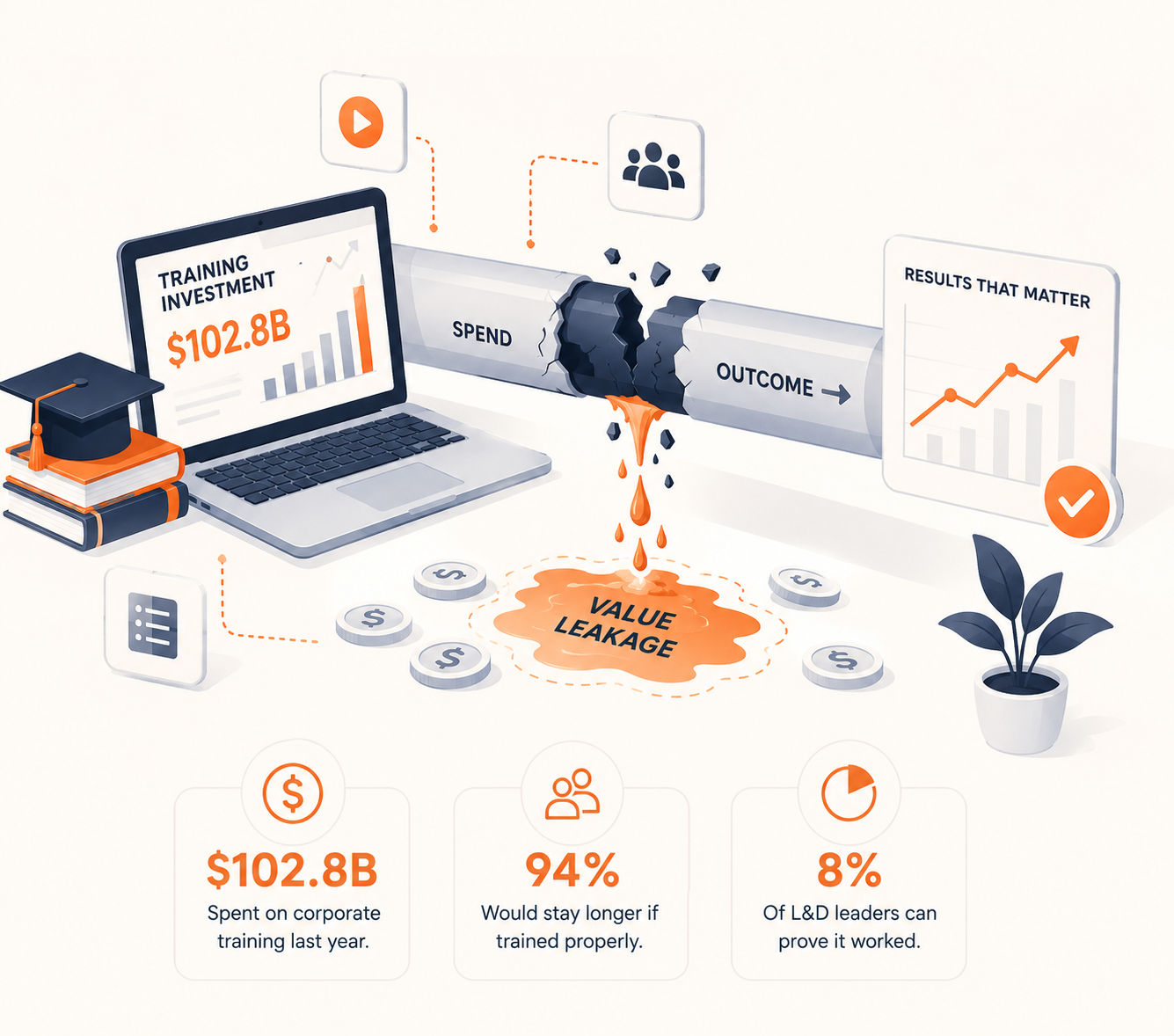
Training exists. The outcome doesn’t.
Somewhere between the spend and the result, it’s leaking.
$102.8B
94%
8%
None of that’s a content problem. It’s a platform that was never built around how people actually work.
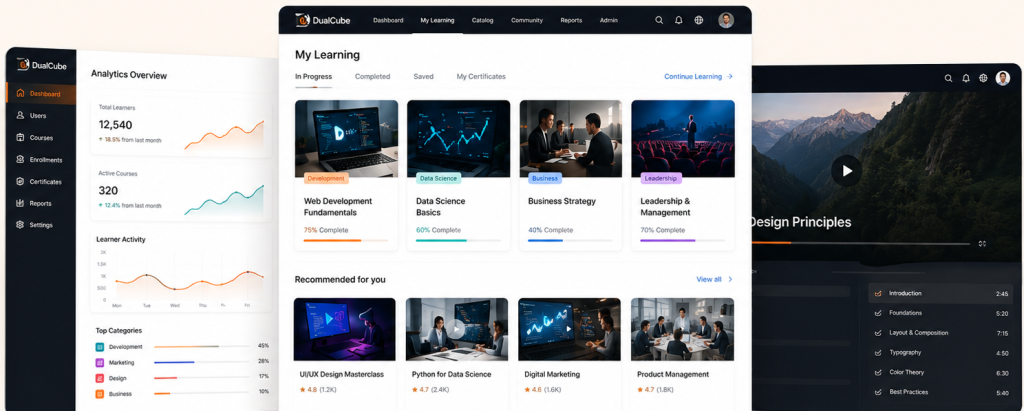
Built to public standards, not around them.
Infrastructure, not another content library.
Accessible by design
Built toward recognised accessibility practices — keyboard navigation, screen-reader compatibility, contrast considerations, and responsive experiences that reach every learner.
Open, standards-based platforms
Built on Moodle and WordPress foundations that you own outright. No proprietary licensing traps or vendor dependency.
Security-conscious architecture
Role-based access controls, encryption, audit logging, and deployment options aligned with your governance requirements.
Multi-department learning ecosystems
Separate departments, agencies, reporting structures, and permissions within one unified platform.
Citizen-facing learning
Public education portals, civic awareness programs, and community learning initiatives designed for every device and connection speed.
Multilingual experiences
Deliver training and public education in the languages your workforce and communities actually speak.
Public platforms should become assets, not subscriptions.
What your current platform proves – and what yours could.
Licensed access
Closed source
Difficult exit
Continuous per-user costs
Accessibility added later
Vendor-controlled hosting
Public money should buy capability that lasts – not dependency that renews forever.
47%
of HR leaders admit their AI training exists to make jobs easier to automate – not to make people more capable.
We build for better performance. Not just more training.
Who this is for.
L&D and HR teams who are done buying more content and are ready to fix the infrastructure underneath it – companies where retention, skills gaps, or “prove the ROI” is the conversation happening in leadership meetings right now.
★ 4.3 on WordPress.org
MooWoodle
Stripe Payment Pro
Quiz Analytics
15+ products over Moodle & WordPress
Ten years of open-source platforms, not a vendor pitch
We’ve built on Moodle and WordPress since our first year — foundations your department can own outright, not rent indefinitely.
Your data stays under your governance
Everything runs on infrastructure aligned with your own security and deployment requirements, not ours. Records stay where your governance model says they should.
Proof, not a proposal
MooWoodle, Stripe Payment Pro and Quiz Analytics run on thousands of live Moodle sites today. What we build for your department stands on that same ground.
IN THEIR WORDS
“We stopped measuring whether people completed training and started seeing where they were actually getting better at the job.”
– L&D Director, Global Organisation
Questions educators ask us first.
Can’t find yours? Scroll to the bottom – a real person answers, fast.
What is a government LMS?
A government LMS is a learning management system designed for public sector organizations to deliver employee training, compliance programs, citizen education, and professional development. It supports secure administration, accessibility, and reporting for government operations.
Why do government agencies need a learning management system?
Government agencies often train large, distributed workforces while meeting accessibility, security, and compliance requirements. A centralized LMS helps standardize training, track completions, manage certifications, and simplify reporting across departments.
Why is Moodle suitable for government organizations?
Moodle is an open-source LMS that gives government organizations greater control over their platform, avoids vendor lock-in, supports extensive customization, and can be deployed according to internal security and governance requirements.
Can one LMS support multiple government departments?
Yes. DualCube develops Moodle platforms that support multiple departments, agencies, user roles, reporting structures, and permissions within a single learning environment while maintaining appropriate access controls.
Does the platform support accessibility standards?
Yes. DualCube designs government LMS platforms with accessibility in mind, including keyboard navigation, screen-reader compatibility, responsive layouts, readable typography, and appropriate color contrast to improve access for all learners.
Can a government LMS deliver public education programs?
Yes. In addition to internal workforce training, the platform can support citizen education, public awareness campaigns, community learning initiatives, and online educational resources for external audiences.
See what your platform is missing.
Tell us how your team works today. We’ll show you where AI genuinely helps — and where it doesn’t.